


Monthly CRO Subscription or One-Off UX Audit: Which Does Your Store Need?
It's Monday morning, let's say in Gothenburg. The owner of an online store opens last month's report. Traffic is about the same as a year ago, ads cost more, and orders are down.
In the inbox, two agencies offer to help with "CRO." One suggests an audit, the other a monthly plan. Both sound reasonable, and it's hard to tell what you would actually get from either.
This article is for owners and e-commerce managers in Sweden who are new to conversion optimization and need to decide where to start.
If you're short on time, here's the gist:
- CRO means finding where visitors drop off and fixing it, so the traffic you already pay for brings more orders.
- A one-off UX audit gives you a diagnosis and a prioritized plan in 2–3 weeks.
- Monthly CRO turns that plan into ready-to-build tasks, a few every month.
- Start with an audit if you have no plan. Choose monthly work when someone is ready to build the changes.
- An audit pays off only when its ideas reach the live site, so decide early who will implement them.
What is CRO, in plain words?
CRO (conversion rate optimization, or konverteringsoptimering in Swedish) is finding the places where visitors stop on their way to buying and fixing them. The goal is more orders from the traffic you already have.
In 2025, online sales in Sweden reached SEK 153 billion, up 10%. Yet 72% of consumers abandoned at least one cart in the past month (PostNord, E-barometern 2025).
In the same report, retailers describe more price-focused shoppers, global discount marketplaces and rising traffic costs. When every visit costs more, losing buyers on the way to checkout hurts more too.
In practice, CRO works in a loop. Analytics (GA4), heatmaps and session recordings show where people get stuck. Each problem becomes a hypothesis, the hypothesis becomes a change on the site, and the change is measured.
You can run this loop once, as an audit, or keep it going every month. See how we work with online stores in Sweden.
What do you get from a one-off UX audit?
A diagnosis and a plan. In 2–3 weeks, a UX expert reviews your site against GA4 and behavior data. You get 30–50 prioritized hypotheses, a presentation with the 10 most critical ones along the user journey, and a Looker Studio dashboard.
Denys Studennikov, COO at Turum-burum, explains why the audit usually comes first: "Everything has its start. Thus, before changing anything, you need to know what to change. That's why the UX audit is the very first step on the way to improving the user interface."
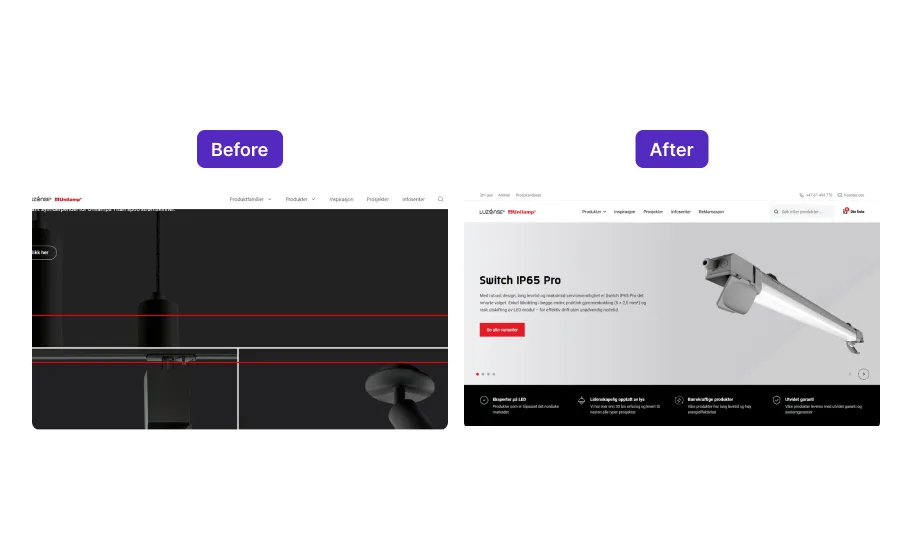
Here is how it worked for Unilamp, a Norwegian manufacturer of architectural lighting. Its WordPress site looked more like a consumer store than a B2B platform, and 41% of new visitors never saw key information about the company.
We ran a full usability audit with more than 50 hypotheses. Then the site was improved step by step, without a relaunch and on the same WordPress. Among the changes: an "About the company" block for new visitors on the home page and clear calls to action on product cards. Conversion to inquiries grew by 41%.
An audit on its own is enough when you have a designer and developer in-house and need a clear plan rather than extra hands. More about the format on our UX audit page.
{{block}}
What does monthly CRO include?
A few tasks every month instead of one long list. Each task covers the problem analysis, the data behind it, one hypothesis, a Figma mockup with a spec for developers, and an estimate of the effect. The minimum term is 3 months, and A/B tests can be added when traffic allows.
Denys Studennikov puts the case for regular work simply: "If you don't make changes to your website regularly, that means you will end up having to completely redesign it every 5 years."
The longest example in our portfolio is Intertop, a Ukrainian footwear and fashion retailer. We started with an audit: a 91-page report with 54 problems and solutions. Then we moved to evolutionary site redesign (ESR): gradual improvement of the interface in sprints, with A/B tests where needed.
In the first year, the conversion rate grew by 55.4%. Over the next three years, it kept growing: +10.5%, +8.7%, and +12.4%.
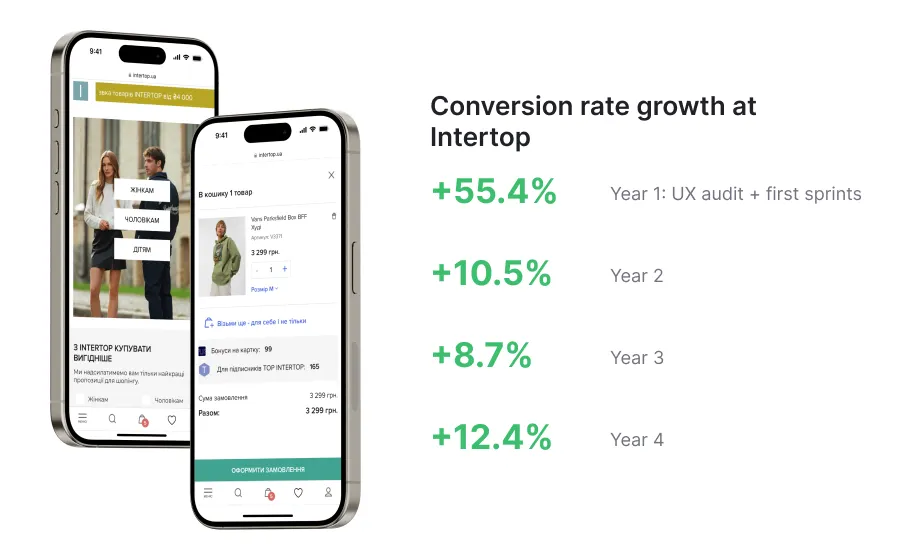
In our experience, the first year brings the biggest wins, because the most obvious problems get fixed first. After that, growth is smaller but steady, since your shoppers, competitors, and product range keep changing.
See what a task includes on our monthly CRO page.
Which format should you start with?
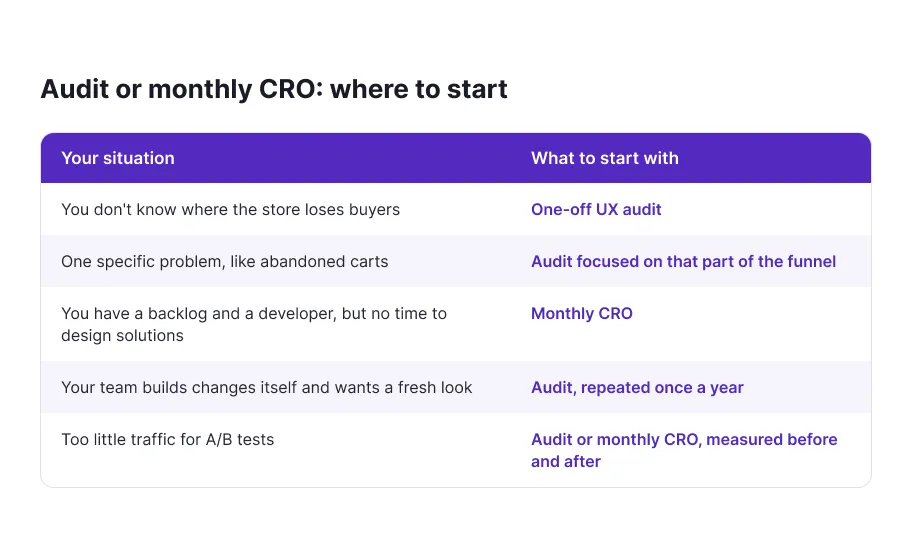
Start with an audit if you don't have a plan yet. Choose monthly CRO when the plan exists and someone is ready to build the changes. If your own team implements everything, a repeat audit once a year may be all you need.
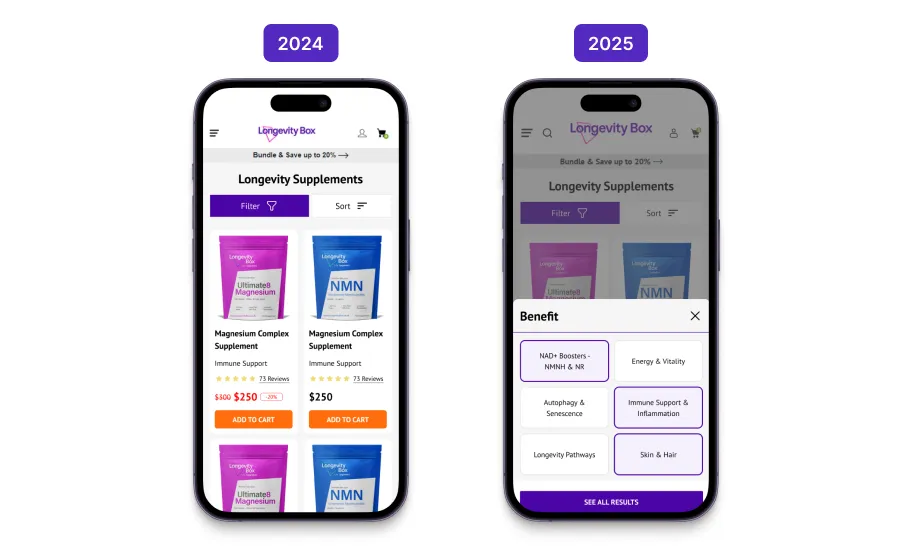
Longevity Box, a UK wellness brand on Shopify, went the repeat-audit way. In 2024, they ordered a 3-week CRO package: a full UX audit with 20 hypotheses and prototypes.
In 2025, they came back for a second sprint with 21 new hypotheses based on fresh analytics. Among the store's results: +76% in revenue.
For many Swedish companies, decisions are made together and step by step. Starting with an audit fits that well: the team sees the findings first and then decides how far to go.
If you want a rough number before that conversation, try our CRO calculator.
{{block}}
How do you make sure the audit doesn't end up in a drawer?
An audit brings results only when its hypotheses reach the live site. Turn each hypothesis into a task with a mockup and a spec, and check how it was built after launch.
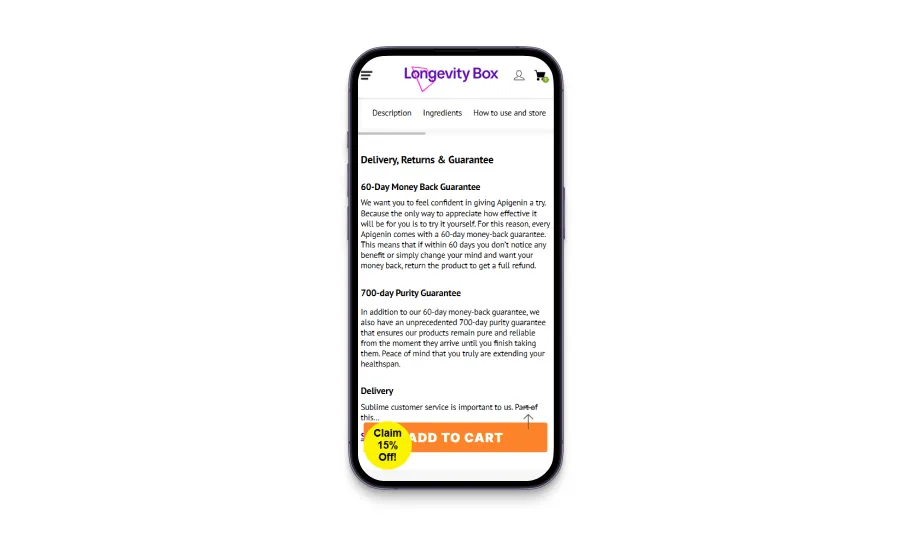
At Longevity Box, the client's own team implemented the changes. So the second sprint started with a review of how the 2024 hypotheses had been built, and we had recommendations on 12 of the 20.
One example: the product page got a sticky Buy button, as planned. But the button had no price, so shoppers still had to scroll up to check it before adding the product to the cart.
In other projects, the changes are built by the agency behind the e-commerce platform. For General Prepper, a Swedish retailer, the developers came from Wikinggruppen, the store's new platform. One of their front-end developers said: "The Figma file was top-notch… the designs were so clear that I didn't even need to bother them!"
How will you know it works?
Before each change, pick one or two metrics and compare them before and after launch, with mobile and desktop counted separately. For a product page, that may be the product page → cart rate; for the cart, cart → checkout.
If your traffic is too small for A/B tests, there are other ways to check the effect. We cover them in [ПОТРІБНО: посилання на статтю про доказ ефекту UX-змін без A/B-тесту, коли її опублікують].
Conclusion
Back to that Monday report. If the owner doesn't know yet where the orders are lost, an audit will show it and say what to fix first.
If the plan is already there but nobody has time to turn it into tasks, monthly CRO keeps the fixes coming, month after month.
{{block}}
FAQ
How long does a CRO audit take?
Our standard UX audit takes 2–3 weeks, from the first look at your data to a prioritized list of hypotheses.
Is a CRO audit a one-off or part of ongoing CRO?
Both are possible. Some stores implement the audit themselves and come back a year later, like Longevity Box. Others move straight to monthly work, like Intertop.
How long should monthly CRO last?
At least 3 months. Shorter than that, there is rarely enough time to build the changes and see their effect in the data.
Who implements the changes: the agency or my developers?
Usually your developers or your platform agency. We hand over Figma mockups with specs and check the result after launch, so the idea isn't lost on the way to the live site.
Question reference
Answer reference





More real-world Turum-burum cases?
Review our vast portfolio of cases in a variety of business fields to make sure of our expertise.
Go to Portfolio
