


Norce vs Centra vs Litium: Which eCommerce Platform Fits Your Business?
What if all three eCommerce platforms on your shortlist can handle your requirements, but choosing the wrong one still makes your next redesign harder and more expensive?
Norce, Centra, and Litium may look similar when you compare features. All three support complex commerce operations, integrations, and international selling. Yet they approach those needs differently. A pricing model that works for a B2B distributor may be less important to a fashion brand managing wholesale collections. And a company that needs its marketing team to update content independently may evaluate frontend flexibility differently from one with an in-house development team.
So how do you know which platform fits your business beyond the feature checklist?
In this guide, we compare Norce, Centra, and Litium by their core capabilities, advantages, architecture, and suitability for different business models. You'll see which platforms deserve consideration for six common eCommerce scenarios, what their technical choices mean for UX/UI and conversion optimization, and which questions to ask vendors before committing to a platform.
Norce vs Centra vs Litium
Norce is worth considering for businesses with complex catalogs, pricing rules, and B2B purchasing requirements. Centra is particularly relevant for fashion and lifestyle brands managing direct-to-consumer and wholesale sales. Litium suits companies evaluating B2B commerce alongside built-in product information and content management. The best choice depends on your business model, integration requirements, frontend resources, and plans for growth.
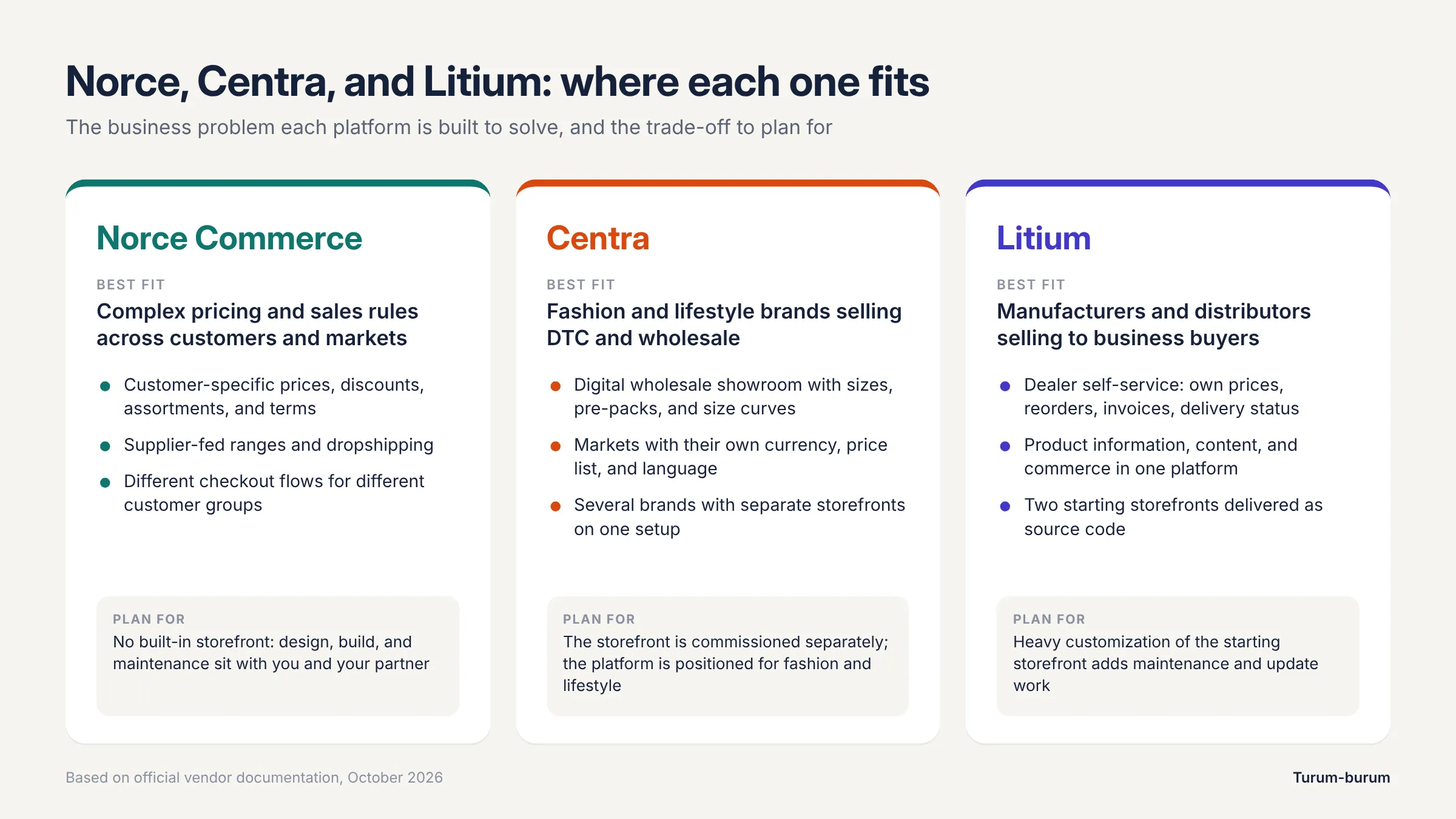
Norce, Centra, and Litium at a glance
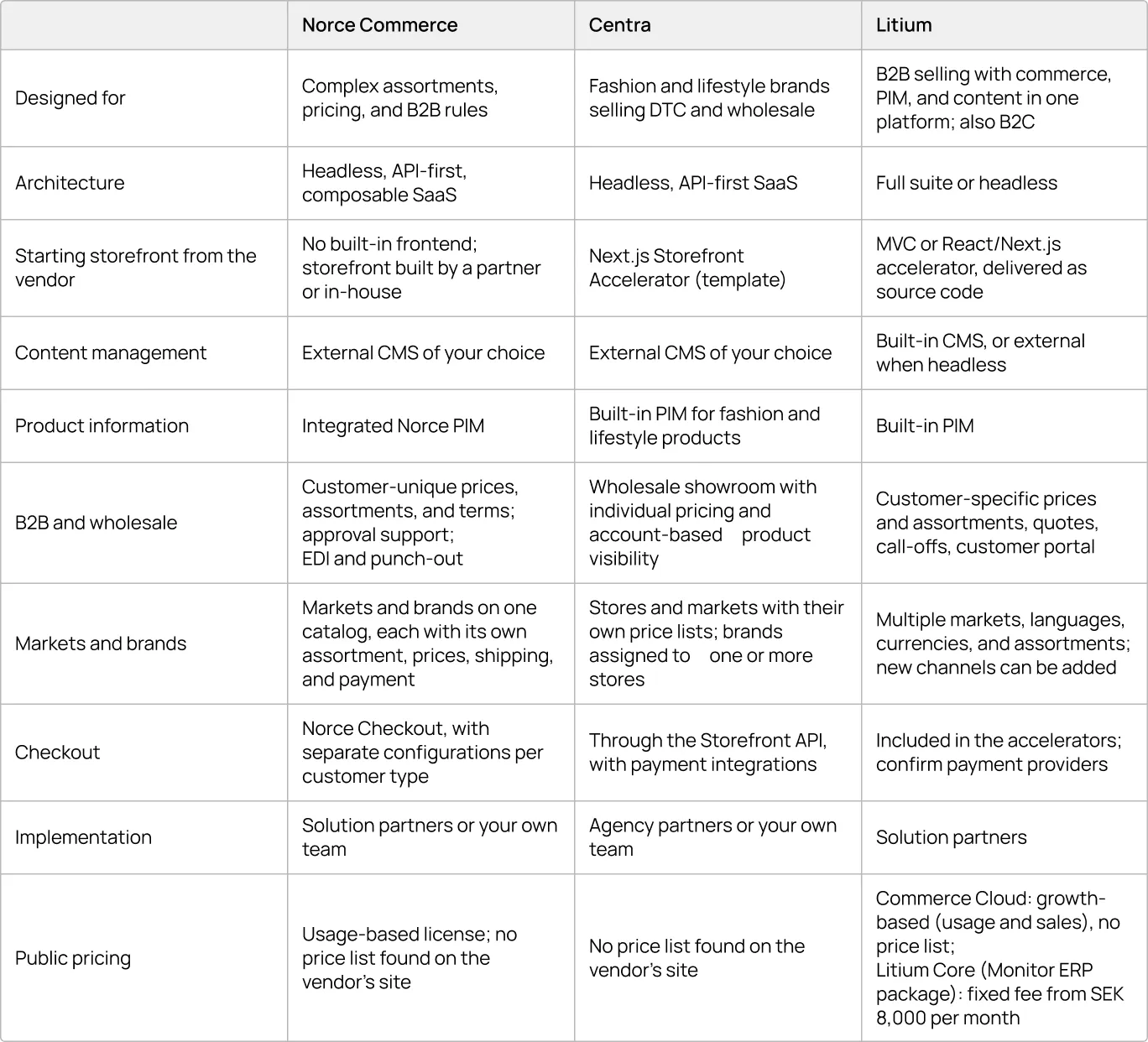
The three platforms differ in architecture, commerce capabilities, and how much of the storefront you need to build and maintain. The table below compares the areas that matter most when preparing your shortlist.
Norce Commerce: A strong option for businesses with complex pricing and sales rules
Many B2B and multi-market sellers don't work from one price list. They have negotiated prices for key accounts, volume discounts for others, product ranges that differ by customer or country, and payment terms agreed contract by contract. As the business grows, keeping those rules right on every order gets harder, and mistakes affect both margins and customer relationships.
Norce is designed for this kind of complexity. Businesses can manage customer-specific pricing, discounts, and product assortments, take prices from the ERP they already use, and apply different sales conditions across customers and markets. With the right setup, customer-specific terms can be applied automatically, reducing the need for manual checks by the sales team. Customers that buy through their own procurement systems can order through EDI or punch-out connections, and your staff can place orders on a customer's behalf when an account still prefers to call.
The same flexibility applies to the product range. Norce can connect to suppliers' systems for stock levels, prices, and delivery times, so distributors can sell products they don't keep in their own warehouse and widen the range without holding stock for every item.
Different customers can also get different ways to buy. A consumer can use a standard checkout, while a B2B customer may need agreed payment terms or a different ordering process. Norce Checkout can run several checkout configurations for different customer groups at the same time.
What should businesses consider before choosing Norce?
Norce doesn't come with a ready-made customer-facing website: the vendor describes the platform as having no built-in front end. Responsibility for the storefront sits with you: you arrange its design, development, content management, and ongoing maintenance separately, usually with one of Norce's solution partners, and those costs belong in the budget from the first estimate.
This matters for future growth as well. A company may run complex pricing and product rules behind the scenes, but customers still need a website where they can easily find products, understand their prices, and complete purchases. How quickly you can improve that experience later depends as much on the team that builds and maintains the storefront as on Norce.
For businesses evaluating Norce, the key question is whether they need its advanced sales capabilities enough to justify the additional work involved in creating and maintaining the buying experience.
Centra: Built for fashion brands that sell to consumers and retailers
Fashion brands that sell both online and through retailers work to two calendars. Consumer sales run every day, in every market the brand serves, with local prices, currencies, and campaigns. Wholesale runs by season: retailers order collections months ahead, in sizes and quantities that have to match what production will deliver. When consumer and wholesale sales run on separate systems, keeping product information, prices, and stock aligned can require additional integrations and coordination.
Centra is built for brands in this position. It is positioned specifically for fashion and lifestyle brands and runs direct-to-consumer (DTC) sales and wholesale from one system, so the wholesale team and the webshop work from the same product catalog, prices, and stock.
For wholesale, the central tool is a digital showroom. Each retailer sees its own prices and only the products selected for its account, browses collections in digital linesheets, and orders in the units fashion wholesale works in: sizes, pre-packs, and size curves. Orders can also be confirmed against stock that is still on its way, which matters when a season sells before it arrives. A large part of seasonal ordering that often runs through spreadsheets and email can move into one place.
For marketing and eCommerce teams, Centra supports selling across multiple markets with localized pricing and product selections. Brands can manage different currencies, price lists, languages, and stock availability across markets, alongside international tax, shipping, and payment options. This allows collections to be priced and presented differently depending on the market.
Brands with physical retail locations can also offer in-store pickup, in-store returns, and ship-from-store. For companies managing multiple labels, Centra allows brands to appear in one or more stores within the same platform.
What should fashion brands consider before choosing Centra?
Like Norce, Centra leaves the customer-facing website to you. It offers developers a starting template, the Storefront Accelerator, and promises any CMS and any design. This gives brands considerable flexibility in how they design the shopping experience. It also means the brand experience, the content tools your team works in, and much of the store's conversion performance depend on the website you commission, so budget for it alongside the platform.
For fashion brands, the storefront needs to do more than reflect the brand's visual identity. It has to help shoppers explore collections, compare styles, choose the right size, and move confidently toward checkout. This is an area Turum-burum, a UX/UI design and CRO agency, knows well: we specialize in UX/UI design and conversion optimization for fashion eCommerce stores, where brand presentation and a smooth shopping experience need to work together. Our article on conversion rate optimization for luxury eCommerce shows how that balance plays out in five redesign stories.
Centra's positioning is fashion and lifestyle. If part of your range doesn't behave like apparel, footwear, or accessories, test early whether Centra can handle it. And if your B2B selling goes beyond wholesale ordering, for example formal quotes or purchase approvals, ask Centra how it would handle them; Litium documents quotes, and Norce documents approval steps.
Litium: commerce, product Information, and content in one platform for B2B sellers
A dealer placing a repeat order wants to see its own negotiated prices, find last month's order, download an invoice, and check when the delivery will arrive, ideally without calling a sales rep. When a manufacturer or distributor can't offer that, the same questions come back by phone and email, and the sales team spends its time answering them.
Litium is built around these needs. Its B2B offering covers customer-specific prices and assortments, volume and tiered pricing, quotes, call-offs, recurring orders, and a customer portal where buyers see their order history, invoices, and delivery status, and manage their own users. For the buyer, the store works like their own account rather than a public catalog. For the sales team, this can reduce routine inquiries and leave more time for complex customer requests. Litium Commerce Cloud serves B2C and B2B2C businesses as well.
The second need sits inside the company. Product specialists maintain technical data, marketing publishes guides, manuals, and campaign pages, and merchandisers set up the store. Litium keeps product information, content, and commerce in one platform, so teams can manage product information and website content in one place, reducing the need to coordinate changes across separate systems. Companies that already have a content management system they're happy with can keep it, because Litium can also run as a headless solution with a separate website layer.
For businesses that manage prices and inventory in an ERP system, reliable integration is especially important. Litium names Monitor ERP, Jeeves, Microsoft Business Central, SAP, Infor, and Visma among the ERP systems it connects to. For manufacturers running Monitor ERP, Litium also offers a packaged option, Litium Core: a ready-made B2B portal that reads customer-specific prices and stock from Monitor and sends orders back to it.
What should businesses consider before choosing Litium?
With Litium, businesses don't have to build their online store entirely from scratch. The platform offers ready-made storefront foundations, called accelerators, which include standard components and functionality needed to launch an eCommerce website.
These accelerators give development teams a starting point that they can adapt to the company's brand, product catalog, and customer needs. Litium provides access to the source code, allowing businesses to customize the shopping experience rather than being limited to a fixed website template.
Using ready-made components can reduce the amount of development work needed to launch a store. However, extensive customization may increase future maintenance and upgrade costs. Before choosing Litium, discuss with your implementation partner which features can be used as they are, what needs customization, and how those decisions will affect the long-term budget.
Which platform fits which business scenario?
Most platform decisions come down to one or two requirements your business can't compromise on. The six scenarios below start from those requirements. Each one suggests which platform deserves a closer look and why, shows what could change that recommendation, and lists what to confirm with vendors before you commit. Use them as a starting point for your own evaluation, not as a ranking.
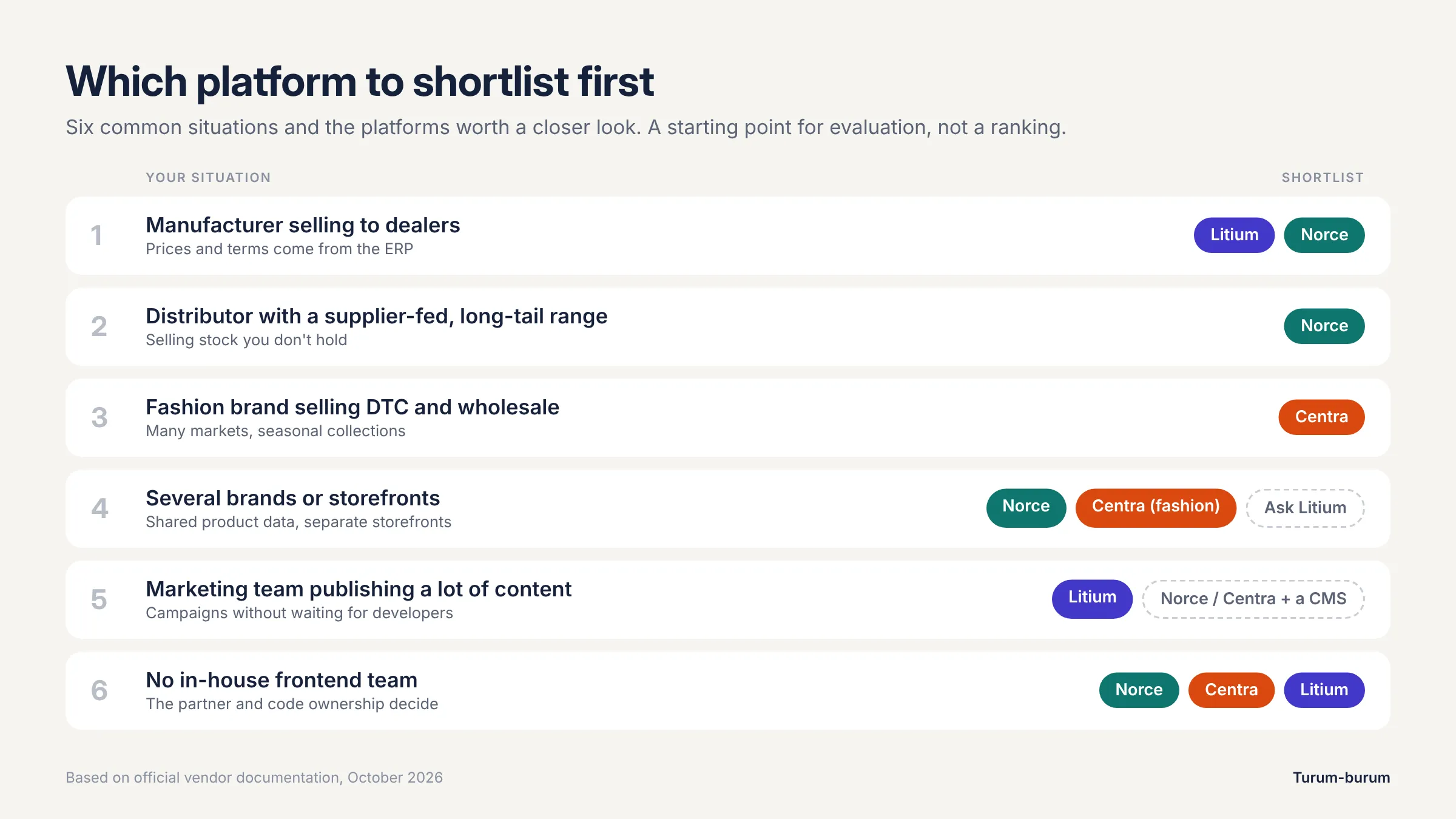
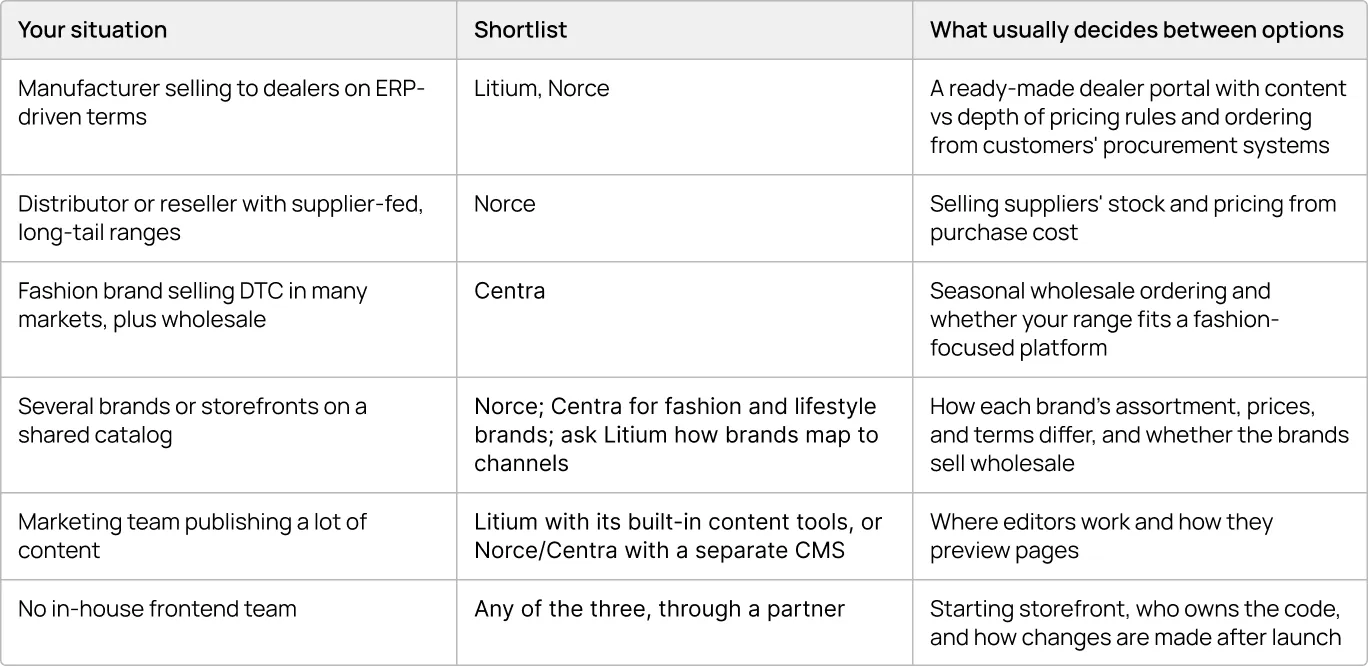
1. You manufacture and sell to dealers on ERP-driven terms
Dealers expect their own prices, their own range, and an easy way to reorder, and both Litium and Norce document these basics. The difference lies in what each platform does best beyond them.
Litium deserves closer consideration when your main goal is to make everyday purchasing easier for dealers: checking their own prices, reordering, finding invoices, and managing colleagues' access without contacting your sales team. These self-service functions are part of Litium's documented B2B scope, and manuals and product documentation can sit in the same system as the store. If you run Monitor ERP, Litium Core is a packaged B2B portal built for that ERP and worth including in the comparison.
Norce moves up the list when the pricing rules themselves are the hard part, for example prices layered by customer, market, and brand, or prices recalculated from purchase costs. It also matters when large customers order from their own procurement systems rather than your website, or when your sales staff still take orders by phone.
Before deciding, run three of your hardest dealer price cases through each platform, and ask whether the platform calculates the price or takes it from your ERP at the moment of ordering. Ask Norce which portal features (invoices, order history, user management) are standard and which your partner would have to build, and ask Litium whether EDI or punch-out is available if you need it. In both cases, check how one dealer account handles several people: the buyer, the approver, and the person who only needs invoices have different tasks.
2. You distribute or resell a long-tail range fed by suppliers
A long-tail distributor needs to offer more products without tying up money in stock, and to protect margins when supplier prices move. Norce's documentation addresses both: besides selling suppliers' stock, it covers dropshipping and pricing based on purchase cost.
The recommendation weakens if most of your range sits in your own warehouse, or if supplier data already passes through a separate product information system or ERP before reaching the store. Then the supplier features matter less, and B2B portal features or content may decide instead, which brings Litium back into the comparison.
Whatever you choose, ask how you would bring in supplier data and who would enrich it. Supplier data often lacks the details your filters need, and delivery promises shown on the product page are only as accurate as the supplier data behind them.
3. You run a fashion brand selling DTC in many markets, plus wholesale
A fashion brand that sells to consumers and to retailers runs two different rhythms side by side: daily online sales across markets, and seasonal wholesale orders placed months before delivery. Centra is built specifically for that combination. DTC and wholesale run on one system, so the wholesale showroom and the webshop share the same products, prices, and stock. That makes Centra the natural shortlist here, and the decision usually comes down to the exceptions below.
The case for Centra gets weaker in three situations: when wholesale runs mainly through EDI with a few large retailers or through marketplaces, when part of your range isn't fashion or lifestyle, or when you need B2B workflows such as formal quotes or purchase approvals. In those cases, compare Centra's answers with Norce and Litium, which document these workflows.
Verify how seasons, pre-orders, and deliveries on incoming stock map to your planning, and which of your ERP, point-of-sale, and logistics systems appear among Centra's integration partners. The consumer experience will also depend on the storefront you commission, so plan that budget from the start.
4. You run several brands or storefronts on a shared catalog
Running several brands on one platform can mean sharing product data and integrations while keeping separate storefronts, assortments, and prices. How inventory is managed depends on the setup. Norce and Centra both document this, but they organize it differently.
Norce organizes it around one product catalog: markets and brands share the catalog, and each brand site gets its own assortment, prices, shipping, and payment methods. That suits brands that differ mainly in commercial rules.
Centra lets a group run separate brand storefronts while sharing one setup behind them. According to its support documentation, selling is organized into stores and markets with their own prices and currencies, and a brand can be shown in one or more stores, so each storefront gets its own product selection. Centra's own published Active Brands case study describes four sportswear and outdoor brands with separate storefronts running on a single Centra setup with shared integrations. For a group of fashion or lifestyle brands, especially ones that also sell wholesale, that makes Centra a genuine candidate.
Litium describes adding new channels and markets to one platform, so ask how it would map your brands to channels.
The brands' business models decide a lot here. If one brand sells B2B on contract terms and another is a fashion DTC brand, a single platform may force compromises on one of them, and two systems can be the simpler option. Licensing matters too, so ask each vendor how an extra brand or store affects your commercial terms.
Also check what the brands will share on the website. Several storefronts only reduce design and development work if you plan shared page templates and components from the start; the platform alone doesn't decide that.
5. Your marketing team publishes a lot of content
When campaign pages and guides fill much of your team's week, the editing tool matters as much as the commerce engine. If every new landing page or seasonal update requires developer support, marketing teams have less control over how quickly campaigns can go live. Litium includes its own content management, so editors and merchandisers can work in one system. Norce and Centra pair with a separate content management system, which gives you the choice of tool and adds an integration to maintain.
If your team already uses a content management system it is happy with, that tips the balance toward keeping it, and Litium can also work with a separate one.
The point to test in any setup is the editor's daily work: can they build a campaign page from ready components, and can they preview it with live products and prices before publishing? Preview support differs between content management systems and integrations, so ask to see it working with your data rather than in a slide.
6. You have no in-house frontend team
All three vendors work with implementation partners, so this doesn't rule any of them out. It changes what you compare. Centra and Litium both offer starting storefronts; Norce has no built-in storefront, so with Norce the starting point depends on the partner you choose.
If you plan to build an in-house team later, code ownership and documentation matter more than the speed of the first launch.
Ask each partner who owns the storefront code, how they apply updates to the starting storefront, and how you request, price, and release small UX changes after go-live. Conversion work continues long after launch, and slow, expensive changes limit how much of it you can do.
When two platforms both fit, the deciding factors are usually who will own the storefront, which partners have capacity and relevant experience, and how much integration work each option needs. Our guide to choosing eCommerce technologies covers the wider selection process.
What your platform choice means for UX/UI and CRO
The platform sets the limits of the buying journey; the implementation decides how easily you can change it. Neither alone determines how quickly you can test and improve, so evaluate both.
1. Storefront ownership affects the speed and cost of change
When the platform doesn't include the storefront, someone has to design, build, and maintain every page template. Marketing and merchandising teams can often update banners, content, and product information themselves, but changes to page layout or to the steps of the buying journey usually need developers. A vendor's starting storefront gives you a documented head start; heavy customization of it brings back much of the effort.
To evaluate: list five changes you would expect to make in the first year, such as a new filter, a reordered product page, or a different checkout step, and ask who would make each one, in which tool, and how long a release takes.
2. Find out what happens when a requirement isn't standard
Every platform separates what works out of the box, what can be configured, what needs an add-on or integration, and what has to be custom-built. A design that crosses that line without anyone noticing turns into a change request late in the project, with extra cost and delay.
Before you approve the design, mark each requirement as standard, configuration, add-on, or custom, and ask the partner to price the last two. Where a standard component can meet the need with a different layout, start there.
3. Give each buyer group its own path
Consumers, logged-in B2B buyers, wholesale accounts, and order approvers arrive with different tasks. Each platform documents its own way to separate them, as the sections above show, but none of them designs the paths for you.
The platform makes separate paths possible; navigation, entry points, and account pages decide whether buyers find and use them. Map each group's main task before design starts. Our article on UX for B2B and B2C covers how the two journeys differ.
4. Let product data decide navigation, filters, and search
Shoppers can only filter and search by the information your catalog holds. Evaluate each platform's product information tools with your own data: sizes and variants for fashion, technical specifications for B2B, supplier fields for long-tail ranges.
Ask to see your most difficult product family set up on the platform, then check whether the details your filters need would be filled in across the range. Our filters checklist helps decide which filters matter.
5. Plan experimentation before the build
How easily you can A/B test after launch depends on the platform and on how your storefront is built. Centra says that because its storefront is separate from the platform, you can quickly A/B test different designs, and Norce says its checkout setup allows A/B testing of checkout flows. A testing tool added to the website, experiments built into the storefront itself, and alternative checkout configurations are the usual options. Each approach has different implementation and analytics requirements, and some may introduce additional performance considerations.
Decide during the build which testing approach you will use, which analytics events define success, and how a winning variant goes live. A GA4 audit before go-live helps keep the data comparable, and our article on A/B testing in UX design covers when a test is worth running.
{{block}}
Questions to answer before you choose a platform
Settle these with the vendor, the implementation partner, and your own team before you sign.
- Roadmap: Which buyer groups, markets, and sales channels will you serve in three years?
- Scope: Which requirements work out of the box, which need configuration, which need an add-on or integration, and which are custom?
- Pricing logic: Can the platform express your most complex price rules, or will the ERP calculate them?
- Product data: How will the platform model your most complex product family, and who owns its data?
- Frontend: Which starting storefront will you use, who owns the code, and who can change each template after launch?
- Content: Which CMS will editors use, and can they preview pages with live products and prices?
- Integrations: Which systems (ERP, payments, search, CRM) connect, through what, and who maintains each connection?
- Measurement: Which testing approach will you use, and which baseline metrics will you record before launch?
- Commercial terms: How is the license calculated, and what does it include?
A discovery phase is a good place to answer them.
Choose by where your complexity lives
Norce, Centra, and Litium are all serious digital commerce platforms, and none is the right answer for every business. Norce deserves the first look when pricing, assortments, and customer-specific rules are the hard part. Centra fits fashion and lifestyle brands that sell to consumers and retailers at the same time. Litium suits B2B-led sellers who want commerce, product data, and content in one platform, with a starting storefront delivered as source code.
Feature lists will show you where the three overlap. The differences that shape the project appear when you ask who builds the storefront, how the platform models your product data, and what happens to requirements the platform doesn't cover as standard.
Shortlist by your business requirements. Make the final decision with implementation, integrations, and long-term ownership in mind.
FAQ
Is Norce Commerce headless only?
Yes. Norce describes its platform as completely headless and API-first, with no built-in frontend. The storefront is built on Norce's APIs by a solution partner or your own developers, together with the CMS and search tools you choose.
Can non-fashion brands use Centra?
Centra built its platform specifically for fashion and lifestyle brands, and its product model, wholesale tools, and market setup reflect that. If your products don't behave like apparel, footwear, or accessories, test how Centra would model your catalog before you shortlist it.
Does Litium include a CMS?
Yes. Litium can run as a complete suite with built-in CMS and PIM, or headless with a separate frontend and CMS. It offers an MVC accelerator and a React/Next.js accelerator as starting storefronts, both delivered as source code.
Which platform supports customer-specific B2B pricing?
Norce and Litium both document customer-specific prices and assortments as B2B features. Centra documents individual pricing for wholesale accounts in its digital showroom. Test your actual rules, such as volume tiers or contract prices from your ERP, with each vendor.
Can you run A/B tests on a headless eCommerce platform?
Yes. Tests usually run through a testing tool in the frontend, as server-side experiments, or through alternative configurations such as different checkout flows. Choose the approach and define analytics events during the build, because each option needs different development and tracking work.
Question reference
Answer reference




More real-world Turum-burum cases?
Review our vast portfolio of cases in a variety of business fields to make sure of our expertise.
Go to Portfolio
